Blog
Back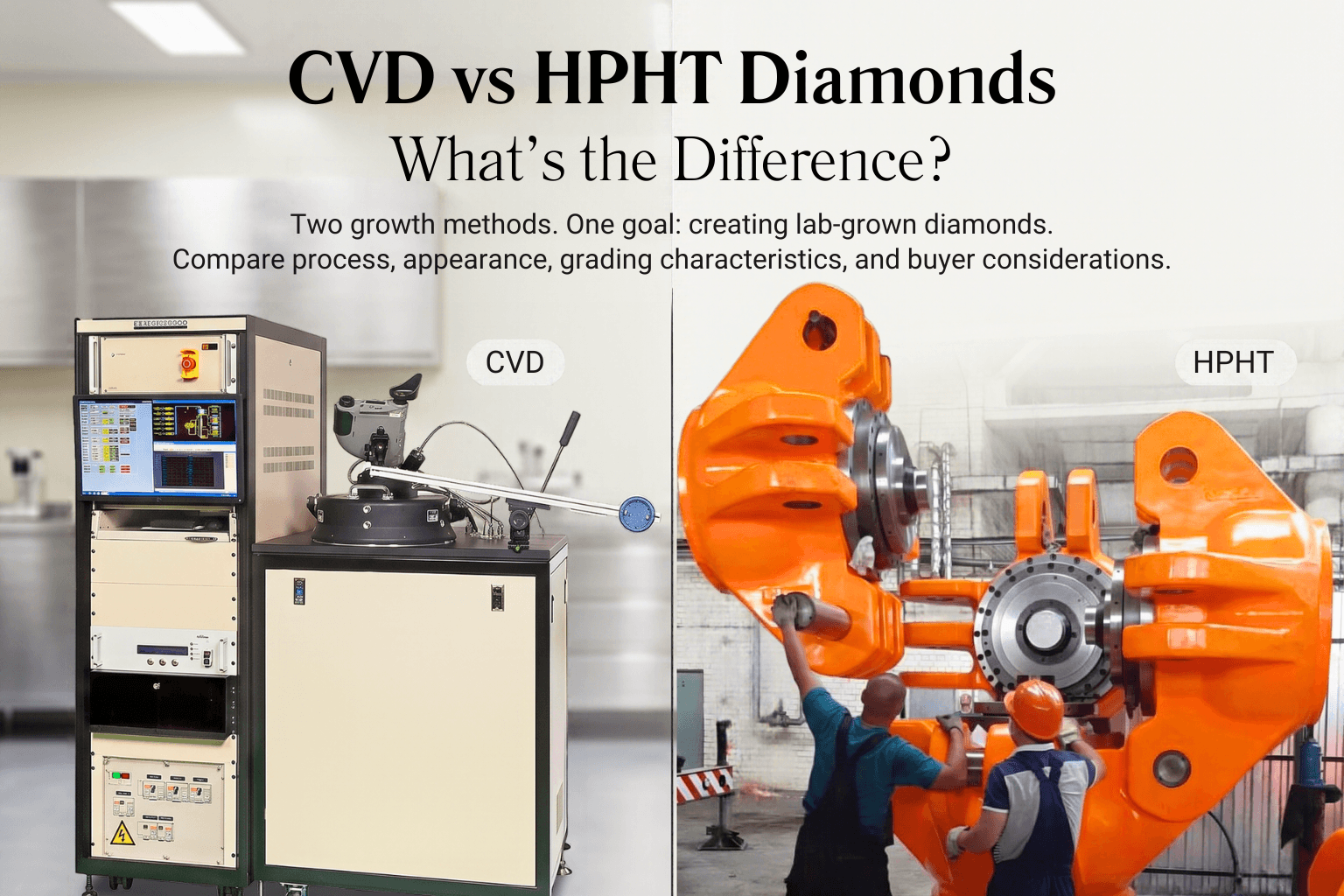
CVD vs HPHT Diamonds: What’s the Difference?
If you are comparing CVD vs HPHT diamonds, the difference is not simply about how the stone was made. Both methods produce lab grown diamonds, but they use different growth environments, which can influence appearance, grading characteristics, availability and pricing.
For buyers, the real question is usually not which process sounds more advanced, but how each option compares when you are looking at an actual stone. If you are weighing HPHT vs CVD diamonds, it helps to understand what the grading report shows, how the diamond presents visually and whether the specification suits your requirement.
In this guide, we’ll break down how both methods work, where the differences matter and what to compare before making a decision.
What Are CVD and HPHT Diamonds?
CVD and HPHT describe two different processes used to grow diamonds in a laboratory setting. CVD stands for Chemical Vapour Deposition, a process in which carbon-rich gases help a diamond crystal grow layer by layer under controlled conditions. HPHT means High Pressure High Temperature. In this process, a diamond crystal develops under carefully controlled heat and pressure around a seed.
Whichever process is used, the result is still a lab-grown diamond with the same fundamental carbon crystal structure
associated with natural diamonds.
When comparing HPHT vs CVD diamonds, it is important to remember that
the method does not act as a quality grade. A stone should still be assessed on its individual specifications,
appearance and certification. The same applies to CVD lab grown diamonds: the production method explains how the
diamond was created, not whether it is automatically better or worse.
How CVD Lab-Grown Diamonds Are Made
The CVD process starts with a small diamond seed inside a controlled chamber. Carbon-rich gases are introduced, allowing the crystal to build gradually, layer by layer, until it reaches the required size.
For buyers, the key point is that CVD lab grown diamonds are defined by how they are produced, not by a fixed quality level. The finished stone should still be judged on its own grading, proportions, appearance and certification.
How HPHT Lab Grown Diamonds Are Made
With HPHT, a diamond seed is placed alongside a carbon source inside specialised equipment. High heat and pressure then encourage the carbon to form around the seed, building a larger crystal over time.
This approach is fundamentally different from CVD. Rather than building the stone through carbon-rich gases in a controlled chamber, HPHT relies on intense heat and pressure to encourage crystal growth.
When comparing HPHT vs CVD diamonds, the most important distinction is therefore the environment in which the crystal develops. Both methods can produce high-quality lab grown diamonds, but the growth process itself does not determine whether one finished stone is automatically better than another. Buyers should still compare the individual diamond’s grading, proportions, appearance and certification before making a decision.
CVD vs HPHT: What Actually Differs?
The clearest way to compare CVD vs HPHT diamonds is to look at how each stone is grown and the characteristics that may result from that process. Neither method automatically produces a better diamond; the finished stone still needs to be judged individually.
|
Factor |
CVD |
HPHT |
|
Growth environment |
Lower pressure, gas-based chamber |
Very high pressure and high temperature |
|
Growth process |
Carbon is deposited onto a diamond seed layer by layer |
Carbon crystallises around a seed under intense heat and pressure |
|
Typical rough crystal characteristics |
Often develops in flatter, layered growth |
Commonly forms in a more compact crystal structure |
|
Potential colour characteristics |
Some stones may show brown, grey or other growth-related tones |
Some may show yellow, blue or other growth-related colour characteristics |
|
Typical inclusions |
May show growth lines or other process-related features |
May contain metallic inclusions from the growth environment |
|
Post-growth treatment |
Some stones may receive treatment to improve colour |
Treatment may also be used depending on the stone |
|
Suitable applications |
Suitable for jewellery across a wide range of shapes and sizes |
Equally suitable for jewellery, depending on the individual stone |
When comparing CVD diamonds vs HPHT, the growth method is only one part of the decision. Grading, proportions, appearance and certification still matter more than the label alone.
Does CVD or HPHT Produce a Better Diamond?
There is no universal winner when comparing CVD and HPHT. The growth method tells you how the diamond was created, but it does not determine the finished stone’s quality on its own.
What matters more is the individual diamond in front of you. Check the grading report, review the colour and clarity, compare the cut and measurements, and look at any treatment information that may be listed. Two stones grown by the same method can still differ noticeably in appearance and overall value.
So if you are asking which process produces the better diamond, the more useful answer is: judge the stone, not just the method. For a fuller breakdown of what to compare before buying, see our guide on How to Choose a Lab Grown Diamond: A UK Buyer’s Guide
What About Colour, Clarity and Post-Growth Treatment?
Because CVD and HPHT diamonds develop in different growth environments, they can show different characteristics. These should always be assessed on the individual stone rather than assumed from the production method alone.
- Colour characteristics
Some CVD-grown stones may show brown, grey or other growth-related tones, while HPHT-grown diamonds can present different colour tendencies depending on the conditions in which they formed. - Clarity and internal features
The two processes can create different inclusion patterns or internal characteristics, which may be noted during grading. - Post-growth treatment
Some stones may receive treatment after growth to improve colour or appearance. Where relevant, this should be disclosed on the grading report. - Check the certificate
Buyers should review the report for treatment details, recorded characteristics and the exact specification of the stone. - Judge the finished diamond itself
The better approach is to assess the actual stone rather than assume quality based only on whether it was grown by CVD or HPHT.
How the Growth Method Appears on a Diamond Certificate
A grading report can help confirm whether a lab-grown diamond was produced using the CVD or HPHT method, which is far more reliable than relying only on a supplier description.
For CVD lab grown diamonds, the report may identify the growth process and, where relevant, note any post-growth treatment. The same principle applies when comparing lab grown diamonds CVD vs HPHT: check the document itself for the recorded method, treatment details and the full stone specification.
The report number should also correspond with the diamond being offered, so buyers can verify that the certificate matches the actual stone. That extra check adds confidence and makes comparisons easier, particularly when several diamonds appear similar on paper.
This section can link naturally to the homepage certification area for buyers who want more detail on grading and report information.
CVD vs HPHT for UK Jewellery Buyers
CVD
- Suitable across a wide range of jewellery applications when the individual stone meets the required specification.
- Buyers should compare colour, measurements, availability and matching needs.
- Best judged by the finished diamond rather than the growth method alone.
HPHT
- Equally suitable when the grading, dimensions and appearance fit the intended design.
- The same checks matter for pairs, side stones and repeat sourcing.
- Selection should still be based on the actual stone, not simply the process name.
For UK buyers, the clearer approach is to compare stone against stone, then choose the option that best fits the design and sourcing requirement.
What Should You Check Before Buying?
Before choosing between CVD and HPHT, it helps to run through a few practical checks:
- Grading Report
Review the certificate and make sure the recorded details match the stone being offered. - Growth Method
Confirm whether the diamond was grown using CVD or HPHT rather than relying only on the product description. - Post-Growth Treatment
Check whether any treatment information is listed on the grading report where applicable. - Exact Measurements
Make sure the dimensions suit the intended design, especially for matched or specification-led requirements. - Jewellery Application
Consider how the stone will be used, whether as a centre stone, pair, side stone or part of a multi-stone setting. - Supplier Information
Look for clear communication around grading, availability and the exact specification being supplied. - Current Availability
Confirm that the stone is actually available before making your final decision.
Final Thoughts
When comparing CVD vs HPHT diamonds, the growth method should be treated as one part of the buying decision, not as a quality grade on its own. What matters more is the individual stone: how it has been graded, whether any treatment is disclosed, how the measurements suit the intended jewellery piece and whether the specification matches your requirement.
A clear grading report and transparent supplier information make that comparison easier. If you want help reviewing available options or discussing a specific requirement, the Lab Diamonds UK team can guide you through the details before you decide.
FAQs
Is CVD better than HPHT?
Not necessarily. Neither growth method is automatically better. The finished stone should be assessed on its own grading, proportions, appearance, treatment information and suitability for the intended jewellery piece.
Are CVD and HPHT diamonds real diamonds?
Yes. Both CVD and HPHT processes produce laboratory-grown diamonds. The difference lies in how the crystal is grown, not in whether the finished stone is considered a diamond.
Can you tell whether a diamond is CVD or HPHT?
The most reliable way is to check the grading report. Recognised laboratory certificates may identify the growth method and, where applicable, note post-growth treatment information.
Does CVD or HPHT affect diamond price?
It can, but the growth method is only one pricing factor. Shape, size, grading, measurements, treatment, availability and current market conditions can all influence the final price of an individual stone.
Which growth method should jewellery buyers choose?
Rather than choosing CVD or HPHT by name alone, compare the actual diamonds available. Check the grading report, measurements, appearance, current availability and whether the stone suits your design or sourcing requirement.